Report on NIH Collaborations with Other HHS Agencies for Fiscal Year 2024
This reporting is historical and covers activities prior to January 20, 2025.
Introduction
This annual report captures the extent and nature of activities undertaken by the National Institutes of Health (NIH) in collaboration with other divisions of the Department of Health and Human Services (HHS). Tasked with improving the health of the American public, collaborations among the different divisions of HHS are vital to the success of the department as a whole. In recognition of the important role of collaborations between HHS divisions, Congress added section 403A(a) of the Public Health Service Act, 42 U.S.C. § 283a(a), Annual Reporting to Increase Interagency Collaboration and Coordination, via Section 104 of the National Institutes of Health Reform Act of 2006. This law mandates that the NIH Director provide to the Secretary of HHS an annual report on NIH’s collaborations with other HHS divisions.¹ This, NIH’s eighteenth report to the Secretary, covers Fiscal Year 2024 (FY24).
Background
The HHS mission is to enhance the health and well-being of all Americans, by providing for effective health and human services and by fostering sound, sustained advances in the sciences underlying medicine, public health, and social services.
In FY24, HHS worked towards implementing its mission through the activities of thirteen operating divisions, including ten agencies in the U.S. Public Health Service and three human service agencies, which administered HHS’s multifaceted programs and initiatives. In addition, staff divisions of the Office of the Secretary provided leadership, direction, and policy guidance to the Department. Together, in FY24, this ‘HHS Family’ covered a vast spectrum of activities that affect health and human services outcomes. These activities were enhanced by interagency collaborations that enabled divisions to combine their knowledge and expertise to accomplish their collective missions. This cross-agency teamwork is necessary to create a collaborative community within HHS that accelerates progress in healthcare, public health, human services, and research.
As the largest research arm of HHS, NIH’s mission is to seek fundamental knowledge about the nature and behavior of living systems and apply that knowledge to enhance health, lengthen life, and reduce illness and disability. NIH’s collaborative efforts with other HHS divisions are vital to transforming fundamental scientific and technical information into effective, knowledge-based approaches that advance the health and safety of the public, such as disease treatments, preventive interventions, protective health policies and regulations, and public health campaigns. In turn, the information provided by other HHS divisions on public health needs informs NIH research policies and priorities.
The interagency collaborations included in this report cover joint activities undertaken by NIH in FY24 with all other twelve operating divisions of HHS including:
- Administration for Children and Families (ACF)
- Administration for Community Living (ACL)
- Advanced Research Projects Agency for Health (ARPA-H)
- Agency for Healthcare Research and Quality (AHRQ)
- Administration for Strategic Preparedness and Response (ASPR)
- Agency for Toxic Substances & Disease Registry (ATSDR)
- Centers for Disease Control and Prevention (CDC)
- Centers for Medicare & Medicaid Services (CMS)
- Food and Drug Administration (FDA)
- Health Resources and Services Administration (HRSA)
- Indian Health Service (IHS)
- Substance Abuse and Mental Health Services Administration (SAMHSA)
In addition, this report also covers joint activities undertaken by NIH in FY24 with staff divisions within the Office of the Secretary,² including: Office of the Assistant Secretary for Health (OASH), Assistant Secretary for Planning and Evaluation (ASPE), and the Assistant Secretary for Technology Policy/Office of the National Coordinator for Health Information Technology (ASTP/ONC).
FY24 Collaborations by the Numbers
NIH reported 895 collaborative activities with other HHS operating and staff divisions in FY24. These cross-agency collaborations demonstrate the complex array of efforts in which NIH contributes to the HHS mission of enhancing the health and well-being of all Americans. As depicted below in Chart 1, these collaborations span a range of activities, including those devoted to improving healthcare quality and safety, educating the public, and stimulating innovation.
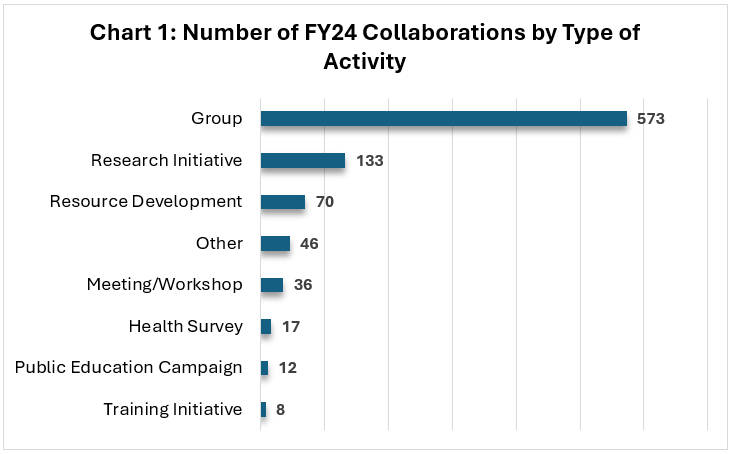
Each FY24 collaborative activity has been categorized based on the nature of the activity. Chart 1 illustrates how the activities break down across the following categories: Group (e.g., committee, work group, advisory group, task force) (573); Research Initiative (133); Resource Development (e.g., database, disease registry, information clearinghouse) (70); Meeting/Workshop (36); Health Survey (17); Public Education Campaign (12); Training Initiative (8); or Other (46).
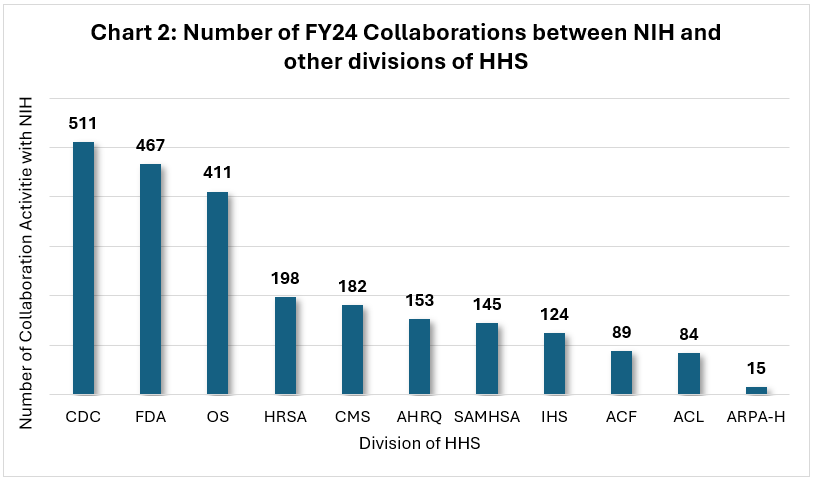
Chart 2 displays the number of reported collaborative activities that NIH engaged in with each HHS operating division, or a staff division within the Office of the Secretary in FY24. As Chart 2 illustrates, most of NIH’s collaborations were with CDC (511) and FDA (467). Given the complementary missions of the CDC, FDA, and NIH, the three divisions often work closely together to build on each other’s strengths and achieve shared objectives. In addition to other operating divisions, NIH also collaborates with the staff divisions of the Office of the Secretary. In this chart, all collaborations with staff divisions are collectively labeled “OS” (411). Individual collaborative activities can involve multiple HHS divisions. Therefore, the values displayed in Chart 2 reflect duplicate counts and add up to more than the total reported sums.
FY24 Collaboration Highlights
NIH works closely with other divisions of HHS to execute the HHS mission. The following exemplars of collaborative NIH activities describe a few of the many efforts undertaken to achieve the HHS mission, organized by four key HHS focus areas: healthcare, public health, human services, and research.
Healthcare
High-quality healthcare is critical for maintaining good health, including through the prevention and treatment of diseases and conditions, such as chronic diseases. To advance healthcare for all Americans, in FY24, NIH collaborated with ASPE, FDA, CDC, CMS, HRSA, IHS, ASPR, SAMHSA, and other divisions of HHS. Outlined below is an illustrative sample of ways in which NIH collaborated with other HHS operating and staff divisions to advance healthcare.
More than 1 in 7 American adults has chronic kidney disease, and as many as 9 in 10 don't know they have it. Launched in 2019 to transform how kidney disease is prevented, diagnosed, and treated, in FY24, NIH continued to participate in the Advancing American Kidney Health Initiative. With participation from across HHS, including ASPR, FDA, and CMS, this initiative aims to improve the lives of Americans suffering from chronic kidney disease, expand treatment options for patients, and reduce healthcare costs. The initiative seeks to deliver on three specific goals: reduce the number of patients developing kidney failure by 25 percent by 2030; reduce the Americans receiving dialysis in dialysis centers as opposed to home in 2025; and to double the number of kidneys available for transplant by 2030.
Pediatric medical devices (PMDs) are tools used to treat, monitor, or diagnose diseases and conditions for children and adolescents. Despite some support for development and innovation, the availability of these devices still falls behind that for adult patients. NIH has played a significant role in the Pediatric Medical Device Public Private Partnership (PMD-PPP), which was launched in 2023 to address this gap. Led by the Foundation for the National Institutes of Health (FNIH), PMD-PPP seeks to connect NIH, FDA, ASPR (BARDA), and non-HHS federal agencies, as well as private sector organizations to achieve the goal of developing PMDs that are effective for children and close treatment gaps. FY24 was marked by the Design Phase of this project, with partners meeting to assemble its governance structure and build a detailed plan for launching the partnership.
In FY24, NIH partnered with ASPE on a variety of healthcare-focused initiatives, including Capturing the Full Trajectory of Patient-Centered Cancer Care Via Enhanced Data Linkages, an initiative to improve healthcare for cancer patients. Linking patient data from complementary sources to generate more evidence on the comparative effectiveness of cancer treatments can help to advance patient care and outcomes. To address this, in FY24, this project linked data from the National Cancer Institute’s (NCI) Surveillance, Epidemiology, and End Results (SEER) program with electronic health record data maintained by the National Center for Advancing Translational Sciences’ (NCATS) National Clinical Cohort Collaborative (N3C). The SEER program is the premier source for cancer statistics, collecting information on incidence, prevalence and survival rates. This information is collected in select geographic areas in the United States, representing nearly half of the American population. Developing and providing access to a high-quality, longitudinal cancer database will improve the efficiency of studies and the robustness of the evidence generated.
Public Health
Advancing public health is paramount to ensuring the well-being and safety of all Americans. By prioritizing preventive care, promoting healthy lifestyles, and implementing other key departmental priorities, HHS works to create a resilient nation where everyone has the opportunity to thrive. In FY24, NIH engaged with a number of HHS operating and staff divisions to improve public health including ACL, SAMHSA, AHRQ and more, as captured by the sampling presented here.
Suicide is an urgent and growing public health crisis. More than 49,000 people in the United States died by suicide in 2022 (i.e., one death every 11 minutes). In FY24, the 2024 National Strategy for Suicide Prevention and accompanying Federal Action Plan were released. NIH participated in the development of this important resource, along with other federal government contributors from HHS—including ACF, ACL, AHRQ, CDC, CMS, FDA, HRSA, IHS, and SAMHSA—and other federal departments. The National Strategy is a bold, new, 10-year, whole-of-society approach to suicide prevention that provides concrete and comprehensive recommendations for addressing gaps in the suicide prevention field. The Action Plan identifies over 200 actions across the federal government to be taken over the next three years to support the National Strategy, including: evaluating community-based suicide prevention; addressing substance use and suicide risk; funding a mobile crisis locator for use by 988 crisis centers and increasing support for survivors of suicide loss. To advance the priorities set out in the National Strategy, NIH participated with several other HHS operating divisions in the National Action Alliance for Suicide Prevention (NAASP)—a public-private partnership.
In FY24, NIH continued to fund and lead the Health and Retirement Study (HRS), which was launched in 1992 and follows over 20,000 men and women over the age of 50 to gain insight into the changing lives of the older U.S. population. Researchers can examine aspects of health care utilization of HRS respondents via the NIA LINKAGE Program, which enables researchers to securely analyze datasets from CMS linked to NIA studies. This longitudinal study has been a lead resource for data on health of older Americans. In particular, HRS explores the changes in labor force participation and the health transitions that individuals undergo toward the end of their work lives and in the years that follow. In FY24, several new findings were published using HRS data, including studies highlighting the impact of isolation on dementia risk and the benefits of hobbies for slowing cognitive decline.
Public health campaigns are critical for raising awareness about conditions and diseases, teaching strategies for disease prevention, and improving health outcomes for whole communities. HHS and NIH often lead these campaigns to ensure that the findings of funded biomedical research can benefit all Americans. The Mind Your Risks campaign, led by NIH, CDC, and CMS, seeks to create awareness and action about the risk factors for stroke and hypertension and how these are related to cognitive impairment and dementia. In FY24, this campaign continued to work with national and community-based organizations to share evidence about brain health and blood pressure, provide prevention strategies, equip healthcare providers with up-to-date research, and support public health efforts to reduce disparities in stroke and dementia.
Human Services
HHS oversees a wide range of programs and services that improve the well-being of individuals, families, and communities. NIH participates in a number of collaborations with other HHS operating and staff divisions, such as CDC, ASPR, and HRSA to bolster these important human services. Illustrated below are a few of the ways in which NIH collaborated across HHS in FY24 to advance human services for all Americans.
To advance the health and care of American Indian and Alaska Native (AI/AN) populations, in FY24, NIH served on the Secretary’s Tribal Advisory Committee (STAC) with other operating divisions, including ACF, ACL, CDC, CMS, HRSA, IHS, and SAMSHA. In FY24, this committee continued to work towards the charge of identifying evolving issues and barriers to access and delivery of services to AI/AN communities, serving as a forum for Tribes and HHS to discuss issues and changes to HHS regulations, discussing concerns and providing guidance for health research and research capacity focused on AI/AN health and wellness, and providing advice on appropriate strategies for Tribal consultations. The overall goal was to ensure effective service delivery, to support inclusion in health research opportunities, and to foster advances in science and technology between federal agencies and Tribal governments as well as its members.
HHS recognizes that, for many individuals across the lifespan, receiving home or personal care can be highly beneficial for promoting independence, tailoring treatments, and ensuring safety. However, family caregivers can often face many emotional, physical, and financial challenges as they care for their loved ones. NIH participates, along with several other HHS operating divisions—including ACF, CMS, FDA, HRSA, IHS, and SAMHSA—on the Recognize, Assist, Include, Support, and Engage (RAISE) Family Caregivers Act Advisory Council. This Advisory Council is charged with providing recommendations to the Secretary of HHS on effective models of both family caregiving and support to family caregivers, as well as improving coordination across federal government programs. As part of this effort, the Advisory Council was charged with development and execution of the 2022 National Strategy to Support Family Caregivers, and in FY24, the Advisory Council released the 2024 Report to Congress on implementation of the National Strategy. The Report showcases the progress that federal agencies made over the previous two years on almost 40 new actions to advance the goals of increasing awareness, bolstering programs, and building more evidence for high-quality caregiving.
Research
HHS supports the conduct of research to expand scientific understanding of health care, public health, human services, biomedical science, and availability of safe food and drugs. NIH strives to continue to lead the nation in innovative biomedical research, much of which is done in collaboration with other HHS operating and staff divisions, as demonstrated by a selection of partnerships described below for FY24.
As the use of artificial intelligence (AI) to enhance and support research activities increases, the need to build dynamic strategies to maximize opportunities for innovation and minimize potential threats to research integrity remains critical. NIH participates in the HHS Artificial Intelligence Task Force (AI TF): Research and Discovery Working Group, composed of several operating and staff divisions such as ACF, ARPA-H, CDC, FDA and IHS. In FY24, the AI TF developed the first HHS Artificial Intelligence (AI) Strategy for the Use of Artificial Intelligence in Health, Human Services, and Public Health. The Research and Discovery Working Group focused specifically on how AI could be used to advance biomedical research while ensuring ethical and responsible practices are maintained.
Major leaps in science are often driven by the invention of new technologies and approaches, and scientific fields are currently seeing dramatic leaps in technologies that allow researchers to use complementary, non-animal-based approaches to study biological functions and human disease. In FY24, the NIH Common Fund Complement Animal Research in Experimentation (Complement-ARIE) program was launched with aims to speed the development, standardization, validation, and use of human-based New Approach Methodologies (NAMs). Collaborating with FDA within HHS, as well as EPA, Complement-ARIE aims to develop tools and methodologies that can more accurately model human biology and complement or even replace more traditional research models. Researchers supported by this program will work towards several initiatives including building a data and NAMs resource coordinating center that will create integrated data structures and a searchable NAMs repository, as well as engaging the community to expand the workforce of researchers that utilize NAMs. The Interagency Coordinating Committee for Validation of Alternative Methods (ICCVAM) is supporting Complement-ARIE efforts to validate and qualify NAMs for broader application, including in regulatory decision making.
Amyotrophic lateral sclerosis (ALS) is a neurodegenerative disease that affects the nerve cells in the brain and spinal cord and causes severe loss of muscle control and paralysis. Over 30,000 Americans are diagnosed with ALS each year and there is no known cure to date. In FY24, to advance understanding of ALS, NIH continued to work with CDC to maintain the National ALS Registry. This registry allows researchers to access data that gives insight into disease pattern changes and identify potential risk factors for ALS patients. Additionally, NIH has partnered with FDA and the FNIH to form the Critical Path for Rare Neurodegenerative Diseases collaboration. This public-private partnership supports the development and regulatory review of treatments for amyotrophic lateral sclerosis (ALS) and other rare neurodegenerative diseases. In FY24, collaborators met to discuss progress toward these goals in accordance with the Accelerating Access to Critical Therapies for ALS Act.
Conclusions
HHS’s mission is to enhance the health and well-being of all Americans, by providing for effective health and human services and by fostering sound, sustained advances in sciences underlying medicine, public health, and social services. The 895 collaborative activities that NIH engaged in with other operating and staff divisions across HHS in FY24 are critical for successful pursuit of that mission. The American public’s investment in NIH provides the nation with a unique resource to advance the broader HHS mission through biomedical research. Collaborations between NIH and other operating and staff divisions enable HHS to draw on the complementary areas of expertise to form partnerships that maximize potential to create meaningful changes in American health outcomes.
NIH appreciates the opportunity to report on its collaborations within HHS. The policies, programs, and regulatory and service activities developed and carried out by HHS operating and staff divisions are some of the most effective means the government can use to provide all Americans with excellent health care, impactful research findings, and high-quality human services. The collaborative activities detailed in this report illustrate how NIH works across the Department to cultivate partnerships, leveraging the respective strengths of all HHS divisions to support the HHS mission, and strengthen the public health and human services ecosystem.
¹ By congressional mandate, NIH is required to report collaborations with other HHS “agencies”, as reflected in the title of the report. For the purposes of the current report, the term “division” is used instead, and refers to both operating and staff divisions within HHS.
² The staff divisions of the Office of the HHS Secretary in FY24 were: the Immediate Office of the Secretary (IOS), Assistant Secretary for Administration (ASA), Assistant Secretary for Financial Resources (ASFR), Office of the Assistant Secretary for Health (OASH), Assistant Secretary for Legislation (ASL), Assistant Secretary for Planning and Evaluation (ASPE), Assistant Secretary for Public Affairs (ASPA), Office for Civil Rights (OCR), Departmental Appeals Board (DAB), Office of Global Affairs (OGA), Office of the General Counsel (OGC), Office of Inspector General (OIG), Office of Medicare Hearings and Appeals (OMHA), and the Assistant Secretary for Technology Policy/Office of the National Coordinator for Health Information Technology (ASTP/ONC).