Introduction
Disability Health Research
More than one in four people in the United States has a disability.1 According to the Americans with Disabilities Act (ADA) of 1990, as amended, a person with a disability is defined as someone who has a physical or mental impairment that substantially limits one or more major life activities, has a record of such an impairment (e.g., cancer in remission), or is regarded as having such an impairment (e.g., a person who has scars from a severe burn).2,3
Disabilities may be present at birth or acquired at any point across the lifespan and are considered a natural part of the human experience. They may be physical, sensory, cognitive, intellectual or developmental, psychological, or related to chronic illness. Disabilities may be visible (e.g., a blind person using a cane) or invisible (e.g., a person with multiple sclerosis who experiences fatigue). They may be temporary or persist for a lifetime. People may have more than one disability, and the nature of their disability or disabilities may change over time. Some individuals and communities may not consider themselves disabled (e.g., Deaf people, many neurodivergent people) but experience discrimination because they are perceived by others to be disabled.
Disability is a complex, multidimensional construct that may be conceptualized and defined in different ways.4-6 Historically, the predominant model of disability in biomedical research and clinical care has been the medical model of disability. The medical model of disability views disability as an individual’s physical or mental impairment(s) that must be “fixed” or “cured” in order to make a person “normal.” In contrast, the social model of disability,7 which has featured prominently in the disability rights movement, emphasizes that disability is not caused primarily by a person’s impairment(s), but rather by environmental, social, and attitudinal barriers that may prevent people from fully participating in society. Increasingly, driven by many in the disability community, disability is understood through interactional models, which posit that disability results from the dynamic interplay between individual medical conditions and biological, behavioral, sociocultural, and environmental factors.8
Like all Americans, disabled people (Box 1) may experience a range of medical conditions that affect their health and well-being. They also may face nonmedical factors9,10 that lead to poorer health outcomes, such as inaccessible health care facilities and equipment.11,12 Disability health research seeks to understand and address the effects of medical conditions, nonmedical factors, and their interaction on the health and well-being of people with disabilities.
Disability health research centers the person rather than the disability. It emphasizes that disabled people have health needs and goals both related and unrelated to their disabilities, the latter of which historically have been overlooked.13
Box 1. Disability Language
The terms “people with disabilities” and “disabled people” are used synonymously in this strategic plan. “People with disabilities” is an example of “person-first language,” whereas “disabled people” is an example of “identity-first language.” Both terms are used in this strategic plan to respect that individuals in disability communities have different preferences regarding the use of person-first versus identify-first language. For a detailed discussion of disability language, please refer to Andrews EE, Powell RM, Ayers K. The evolution of disability language: choosing terms to describe disability. Disabil Health J. 2022;15(3):101328. doi:10.1016/j.dhjo.2022.101328
The Disability Health Research Landscape at NIH
The National Institutes of Health (NIH) supports a broad range of research related to disability across its Institutes, Centers, and Offices (ICOs).14 This research spans the continuum from basic science to clinical, translational, and implementation research. In fiscal year (FY) 2024, NIH invested more than $619 million in disability health research (Figure 1, Appendix A).15,16 This includes investigations into the biological mechanisms underlying physical and mental impairments, medical rehabilitation interventions to improve function and quality of life, and efforts to address disparities in health and health care outcomes experienced by people with disabilities. Disability health research is interdisciplinary and intersects with multiple priority areas at NIH, such as aging, mental health, and chronic health conditions.
Figure 1. NIH Fiscal Year (FY) 2024 Funding Levels for Disability Research15 by Institute, Center, or Office
Total Funding: $619,032,385
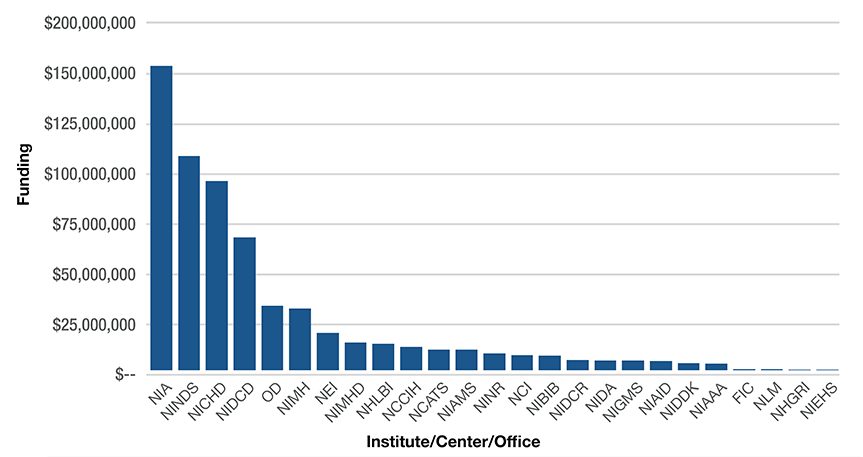
These data are generated from RePORT: Funding of various research, condition, and disease categories (RCDC). The Disability Research area was a new category beginning in FY24.
Although many ICOs fund research that focuses on disability-related topics, efforts have historically been fragmented and typically focused on specific conditions or impairments rather than addressing people with disabilities as a population with unique health and health care needs, with the notable exception of the National Center for Medical Rehabilitation Research (NCMRR) (Box 2). As understanding of disability has evolved, influenced by interactional models of disability and informed by the experiences of disabled people, there has been growing recognition that NIH needs a more harmonized, coordinated, and person-centered approach to disability health research.
Box 2. The National Center for Medical Rehabilitation Research
Following the passage of the Americans with Disabilities Act, the National Institutes of Health Amendments of 1990 (P.L. 101-613) established the National Center for Medical Rehabilitation Research (NCMRR) within the Eunice Kennedy Shriver National Institute of Child Health and Human Development.
NCMRR’s purpose is to support research and research training in medical rehabilitation, coordinate medical rehabilitation research across the National Institutes of Health (NIH), and develop a comprehensive research plan for rehabilitation. For 35 years, NCMRR has promoted the health research needs of people with physical disabilities at NIH through rehabilitation.
NCMRR has done transformative work in medical rehabilitation research and will serve as an essential partner with the Division of Program Coordination, Planning, and Strategic Initiatives to accomplish the work outlined in the NIH Strategic Plan for Disability Health Research FY26–FY30.
For further information regarding NCMRR and rehabilitation research at NIH, please see the NCMRR website and the NIH Research Plan on Rehabilitation.
This recognition led to two major developments. First, in August 2021, the NIH Advisory Committee to the Director Subgroup on Individuals with Disabilities was established. This subgroup consisted of NIH-funded researchers with expertise in disability health research, including researchers with disabilities. The subgroup issued a seminal report to NIH in December 2022 that emphasized the need for an agency-wide approach to disability health research.17 Among other suggestions, the subgroup advised that NIH designate people with disabilities as a health disparity population and create an Office of Disability Research.
Second, in September 2023, the Director of the National Institute on Minority Health and Health Disparities (NIMHD), in consultation with the Director of the Agency for Healthcare Research and Quality (AHRQ), formally designated people with disabilities as a population with health disparities (Box 3).18 This designation helps to encourage research specific to the health issues and unmet health needs of people with disabilities. As the former Director of NIMHD, Dr. Eliseo Pérez-Stable, noted, “This designation recognizes the importance and need for research advances to improve our understanding of the complexities leading to disparate health outcomes [for people with disabilities]….”
These developments, together with an increasing scientific evidence base for disability health research17 and advocacy from disability communities, led the NIH Director in spring 2024 to charge the Division of Program Coordination, Planning, and Strategic Initiatives (DPCPSI) within the Office of the Director (OD) with the strategic coordination of disability health research activities. To carry out this charge, DPCPSI established the Disability Health Research Program (DHRP) within the DPCPSI Director’s Office in July 2024. In September 2024, the DHRP launched the development process for the NIH Strategic Plan for Disability Health Research FY26–FY30. The purpose of this plan is to identify agency-wide strategic goals and objectives to achieve NIH’s disability health research mission: to advance innovative and responsible research that promotes the health and well-being of people with disabilities.
Box 3. Definition of Health Disparities
NIH defines a health disparity as a measurable difference in health that exists between specific population groups. This is a rigorously derived and data-driven determination operationalized by quantifiable metrics, rather than a statement of attribution. It is a scientific starting point that identifies where health outcomes diverge, not a predetermined conclusion about why. Scientific investigations to identify or understand the root causes are separate and distinct scientific questions, which are necessarily multifaceted and complex. NIH funded research is interested in those health disparities that are modifiable or actionable to improve the health of all population groups. Health disparities may be observed in the risks, prevalence, or problems resulting from specific behaviors, as well as the incidence, prevalence, and mortality from conditions, diseases, and/or disorders.
For additional information, please visit NIMHD's health disparities website.
Strategic Planning Process
The DHRP led the development process for the NIH Strategic Plan for Disability Health Research FY26–FY30 in partnership with an internal NIH Disability Health Research Coordinating Committee (DHRCC) composed of representatives from NIH ICOs nominated by ICO Directors (Appendix B). The DHRCC is co-chaired by representatives from the DHRP, NCMRR, and NIMHD.
The DHRP and DHRCC prioritized input and feedback from individuals and organizations with experience and expertise in disability during the development process. Between October and December 2024, the DHRP hosted six community roundtable discussions and a town hall to obtain input from disabled people and interested individuals and organizations regarding disability health research priorities. In December 2024, in coordination with the DHRCC, the DHRP issued a Request for Information (RFI; NOT-OD-25-038) to obtain public input and feedback on the draft framework for the strategic plan. In June 2025, an external Disability Health Research Working Group (DHRWG) of the NIH Council of Councils was established and subsequently provided input and feedback on the draft strategic plan in August 2025.
For additional information regarding the strategic planning process, please refer to Appendix C.
Approach to Priority Setting
The DHRP and DHRCC developed priorities for the NIH Strategic Plan for Disability Health Research FY26–FY30 utilizing information and data from multiple sources. These included:
- Scientific literature and relevant reports
- Input and feedback from NIH subject-matter experts and ICO Directors
- Analysis of the existing disability research portfolio
- Dialogues at the community roundtables and town hall
- Responses to the RFI
- Input and feedback from the DHRWG
Information and data from these sources were synthesized and then used to develop crosscutting themes, goals, and objectives that (1) address pressing public health needs, (2) support promising scientific opportunities, and (3) promote balance in the NIH research portfolio. The crosscutting themes, goals, and objectives were identified and refined in an iterative process by DHRP staff and DHRCC members, the DHRCC co-chairs, and DHRP and DPCPSI leadership.
Strategic Plan Framework
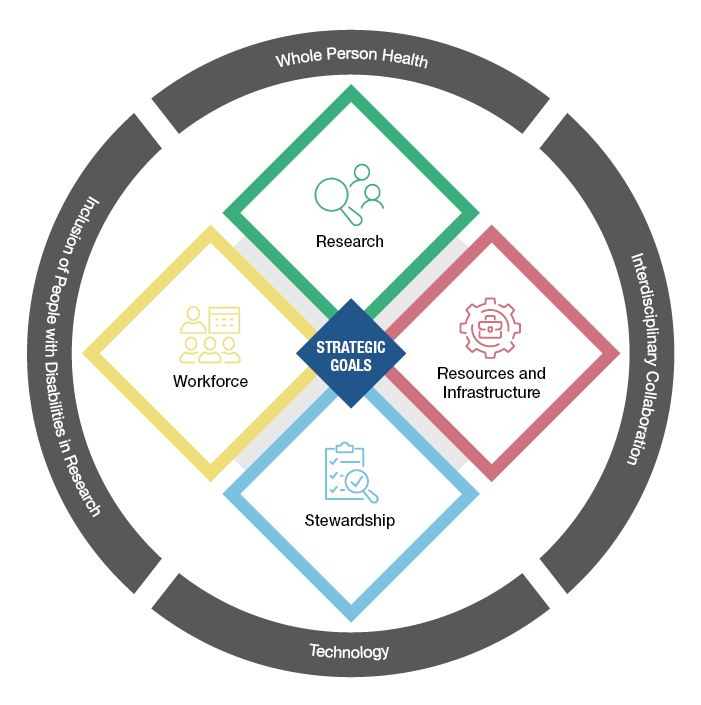
The NIH Strategic Plan for Disability Health Research FY26–FY30 provides a comprehensive and harmonized approach to advancing disability health research activities at NIH. It is organized around four strategic goals, each supported by three to four objectives. Four crosscutting themes identify important overarching considerations that intersect with multiple goals and objectives (Figure 2). The goals, objectives, and crosscutting themes will guide NIH-wide disability health research and are intended to supplement relevant ICO mission areas.
Figure 2. NIH Strategic Plan for Disability Health Research FY26–FY30 Framework
Implementation of the Strategic Plan
The DHRP, in coordination with the DHRCC, will be responsible for implementation and ongoing evaluation of the NIH Strategic Plan for Disability Health Research FY26–FY30. They will develop a comprehensive implementation plan that identifies success metrics for each goal and objective in the strategic plan and outlines the actions and resources needed to meet those metrics over the next five years.
The DHRP and DHRCC will utilize NIH’s Strategic Tracking and Reporting Tool (START) to streamline the collection, tracking, and organization of information to inform progress on the goals and objectives of the strategic plan. START ensures that the information is easily understandable and accessible, facilitating effective sharing with partners both inside and outside NIH. In doing so, START supports NIH’s goal to exemplify and promote the highest standards of scientific integrity, public accountability, and social responsibility in the conduct of science.
The DHRP will provide yearly updates on progress toward the goals and objectives of the NIH Strategic Plan for Disability Health Research FY26–FY30. In addition, the DHRWG will conduct a mid-course review of the strategic plan, reporting on NIH’s progress toward the plan’s goals and objectives, highlighting successes, identifying opportunities and gaps, and informing the development of the next NIH Strategic Plan for Disability Health Research.