
About ORIVA
Learn: #learn
Why ORIVA was Created
How ORIVA Fits into the NIH
How ORIVA is Structured
Why ORIVA was Created #whyoriva
In 2022, Congress directed the NIH to assess its current portfolio for use and development of New Approach Methodologies (NAMs). Accordingly, NIH established an internal working group to examine how NAMs are advancing NIH-supported research.
Following this assessment, in January 2023, the NIH Acting Director charged an NIH Advisory Committee to the Director (ACD) Working Group titled Catalyzing the Use and Development of Novel Alternative Methods to consider how NAMs are being used and to make recommendations on where NAMs may be most applicable or beneficial, especially to advance our understanding of human health. This Working Group included members with expertise in a wide range of technologies, scientific fields, and backgrounds, including members from academia, industry, and other federal agencies with ex officio members from the U.S. Food and Drug Administration (FDA) and Environmental Protection Agency (EPA). To inform these efforts, NIH sought public input through a Request for Information and a public workshop.
The ACD working produced a report identifying seven bold, ambitious, and equitable high priority areas for future investment:
- combinatorial NAMs
- interoperable, reliable datasets
- effective technology dissemination and interconnection
- comprehensive training
- multidisciplinary teams
- socially responsible technologies
- coordinated infrastructure
The ACD Working Group’s report was accepted by the ACD on December 14, 2023. On February 1, 2024, the NIH Director accepted the recommendations and issued a statement on catalyzing the development of NAMs. NIH has since assessed the recommendations for prioritization and feasibility and is currently exploring opportunities through ongoing and new NIH activities.
The Office of Research Innovation, Validation, and Application (ORIVA) is poised to prioritize efforts to reduce our reliance on animal testing and to advance technologies that improve translation to humans while catalyzing interagency collaborations to meet or surpass the recommendations of the ACD Working Group.
Back to top
How ORIVA Fits into the NIH #howoriva
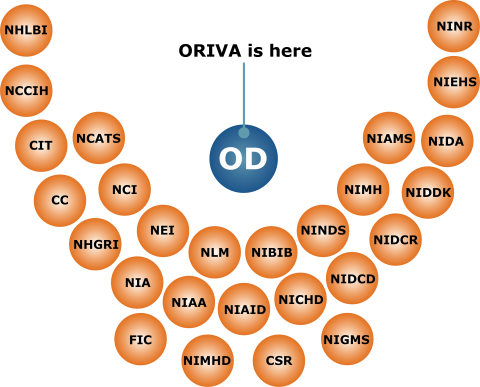
ORIVA is managed by the Division of Program Coordination, Planning, and Strategic Coordination (DPCPSI) in the NIH Office of the Director (OD). The Office of the Director is the central office at NIH, and is responsible for setting policy for NIH and for planning, managing, and coordinating the programs and activities of all the NIH components.
Back to top
How ORIVA is Structured #orivastruct
ORIVA is composed of two divisions, including the Division of the National Interagency Center for the Evaluation of Alternative Test Methods (D-NICEATM) and the Division for Accelerating Innovation in Biomedical Research (DAIBR).
DAIBR will lead a national program to drive NIH extramural investment in human-based research technologies and their application. This division will oversee development of funding opportunities and community outreach to maximize research impact, prioritize approaches with rigorous scientific merit and human relevance, and ensure NIH meets core Presidential and agency goals by accelerating the adoption of new biomedical tools.
D-NICEATM will serve as a central hub for NIH and interagency coordination to advance the evaluation and acceptance of NAMs, develop and evaluate alternatives to animal use for biomedical research, and support U.S. activities with relevant international organizations. D-NICEATM will lead validation and scientific support for ICCVAM’s federal coordination role, and lead NIH’s central hub for evaluating, establishing confidence in, and advancing human relevant NAMs for regulatory safety assessment. D-NICEATM’s scientific, computational, and validation programs will generate high quality data and confidence frameworks required for regulatory uptake of human-based/non-animal approaches to expedite the development of safer and more effective medicines and ensure NICEATM’s work generates scientific data and guidance to expedite replacement of animal testing in alignment with NIH and HHS/MAHA priorities.